

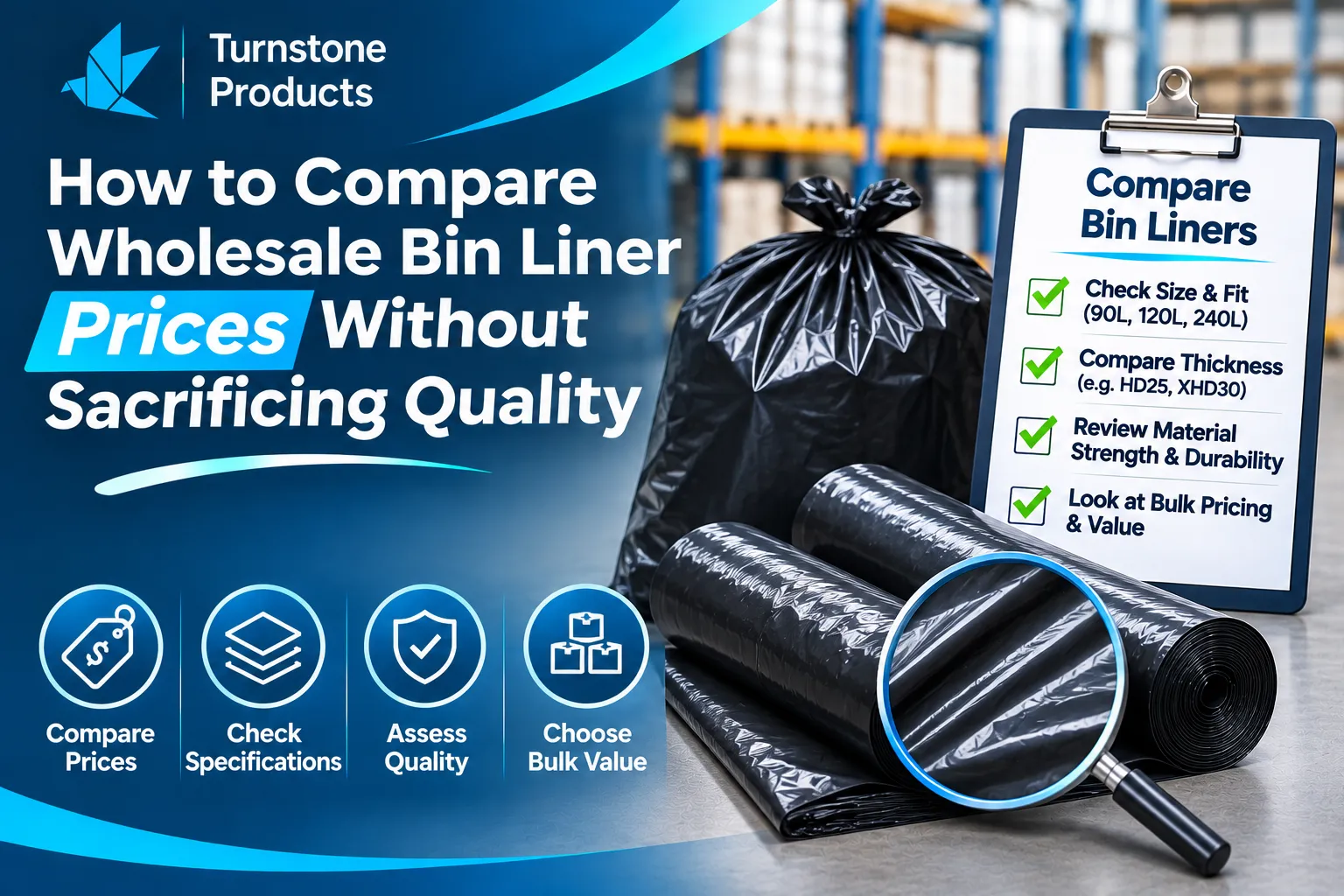
Quick answer: Compare bin liners on cost per bag, not carton price, and only between liners of the same size and grade. Then trial the cheaper option on your real waste for a week. If it splits or gets double-bagged often enough, it can end up costing more than a stronger liner. The best buy is the bag that does the job reliably at the lowest cost per successful use.
Bin liners seem too simple to think about. A bag is a bag, so you pick the cheapest carton. Then the complaints start. Bags tear when they are lifted, cleaners start double-bagging, and someone is mopping up leaks at the loading dock.
For warehouses, restaurants, cleaning contractors and commercial buildings, liners are used by the thousand. Small differences in price and quality add up quickly in both directions. Businesses comparing industrial bin liners can save real money, but only if they compare the right things.
Here is a practical way to do it.
Why Bin Liner Prices Vary So Much
Two cartons that look identical on a quote can hold very different products. Prices vary because of:
-
Thickness. Thicker liners use more plastic.
-
Size. A 240L wheelie bin liner uses far more material than a 54L bag.
-
Bags per carton. One supplier packs 200, another 250 or 280.
-
Plastic blend. Different formulations change how a bag stretches and resists tearing.
-
Manufacturing quality. Consistent thickness and strong bottom seals cost more to produce.
-
Order volume. Larger orders often attract better pricing.
Because of this, the carton price on its own tells you very little.
Step 1: Work Out the Cost Per Bag
Start with a simple formula:
Cost per liner = carton price ÷ liners per carton
Here is a hypothetical comparison:
|
Details |
Supplier A |
Supplier B |
|
Carton price |
$45 |
$56 |
|
Liners per carton |
200 |
280 |
|
Cost per liner |
$0.225 |
$0.20 |
Prices are hypothetical and for illustration only.
Supplier B costs more per carton but less per bag. Over thousands of liners, that gap matters.
There is a catch, though. This comparison only works when both liners are the same size and grade, and suit the same bins. Comparing a light general purpose bag with a heavy duty one on price alone is meaningless. Add any delivery charges to get your final figure.
Step 2: Make Sure You Are Comparing the Same Grade
Bin liner thickness is measured in microns. One micron is a thousandth of a millimetre. Turnstone Products’ range, for example, uses these grades:
|
Grade |
Typical thickness |
Common use |
|
General purpose |
20 microns |
Light, dry rubbish |
|
Heavy duty |
25 microns |
General commercial waste |
|
Extra heavy duty |
30 microns |
Wet, dense or bulky waste |
|
Super heavy duty |
38 microns |
The heaviest loads |
Thicknesses differ between manufacturers, so check each supplier’s specifications.
Thickness is a useful guide, but it is not the whole story. A well-made 25 micron bag with a strong seal can outperform a poorly made thicker one. That is why a real-world test matters.
When assessing wholesale bin liners, check four things before you buy in volume:
-
Fit. Measure your bins’ opening and depth. A liner should sit comfortably with enough overhang to fold over the rim, without stretching.
-
Bottom seal. Weak seals are the most common point of failure when a full bag is lifted.
-
Puncture resistance. Rough packaging and hard edges in general waste will find any weakness.
-
Consistency. Every carton should perform the same as the last.
Sharp or regulated waste should never go into ordinary liners. It needs a designated rigid container and the right disposal process.
Step 3: Run a One-Week Trial
Specifications only tell you so much. The most reliable test is your own waste in your own bins.
Ask suppliers for samples and run a simple trial:
-
Use each liner in the same bins for the same period, ideally a full week including your busiest day.
-
Ask staff to note every bag that tears, leaks or gets double-bagged.
-
Count how many bags were used in total for each product.
-
Ask cleaners which bag they prefer to handle and why.
At the end of the week, you have real failure rates rather than guesses. That number is the key to the next step.
Step 4: Work Out When a Cheap Liner Stops Being Cheap
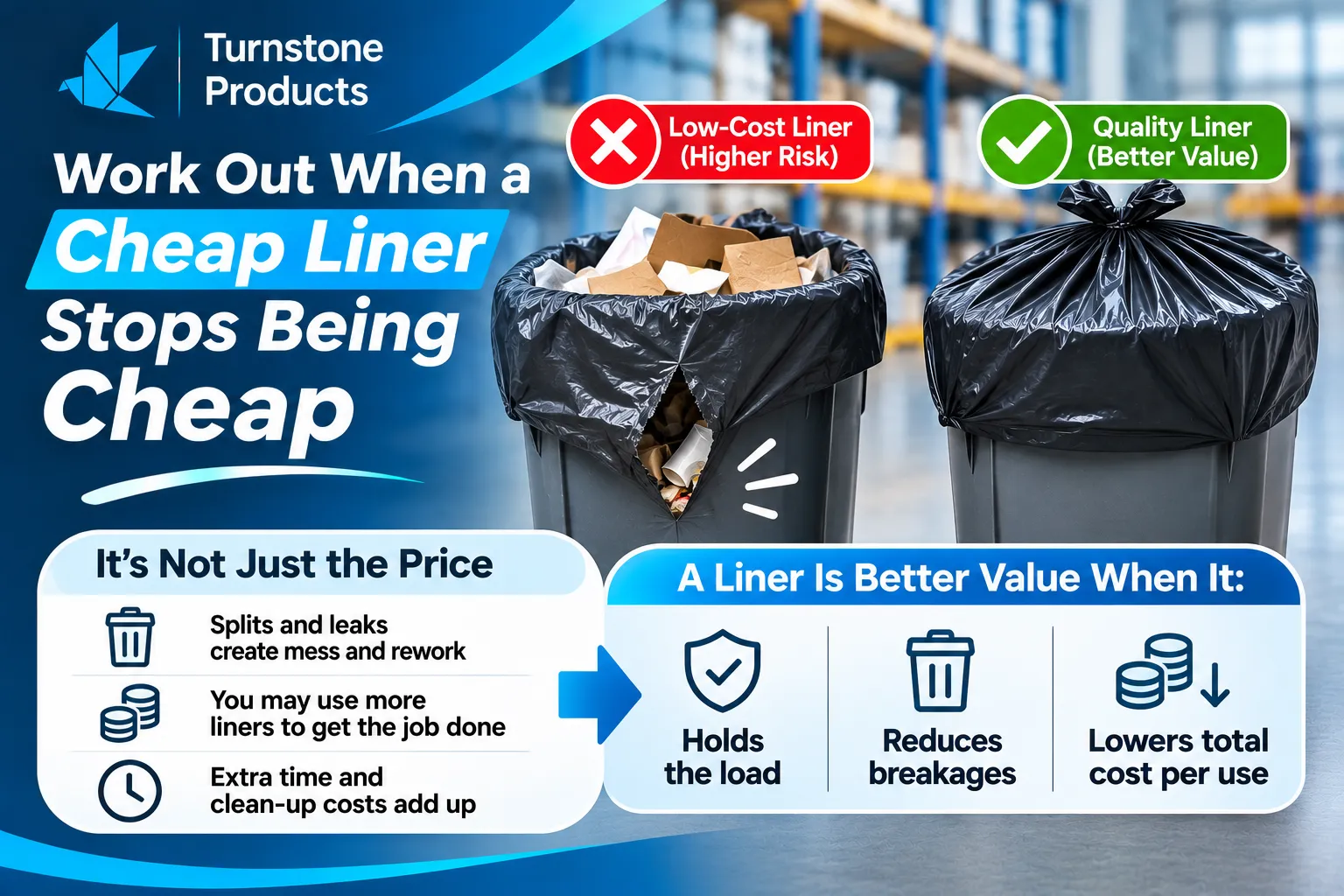
Here is where many businesses get caught out. Say your site uses 1,000 liners a month.
-
A budget liner costs $0.18 per bag, or $180 a month.
-
A stronger liner costs $0.22 per bag, or $220 a month.
On paper, the budget bag saves $40 a month. But how many failures can it absorb before that saving disappears?
Divide the stronger liner’s monthly cost by the budget bag’s price: $220 ÷ $0.18 = about 1,222 bags. In other words, if staff need roughly 222 extra budget bags a month to replace torn ones or to double-bag, the saving is gone. That is a failure or double-bagging rate of about 22 per cent.
That might sound like a lot, but double-bagging in a busy kitchen or warehouse can easily reach that level. And this calculation does not include the cost of cleaning up spills, the floor cleaner used or the time staff lose. Once those are added, the break-even point arrives much sooner.
These figures are illustrative. Use your own prices and trial results.
Step 5: Plan Your Bulk Order
Once you have chosen a liner, buying in volume usually lowers the price further and means fewer orders to manage. Anyone searching for bin liners bulk options should work through a short checklist first:
-
List every bin size on your site and what each one collects.
-
Match a liner size and grade to each bin type.
-
Record how many liners of each type you use per month.
-
Compare the cost per bag across suppliers at the same grade.
-
Confirm bags per carton and how many cartons you need.
-
Check delivery charges and minimum order rules.
-
Keep a small reserve so a late delivery never leaves bins unlined.
This avoids overbuying sizes you rarely use.
Why Choose Turnstone Products?
Turnstone Products is a Western Australian, family-owned supplier of commercial cleaning and workplace consumables, based in Neerabup. It supplies bin liners to commercial cleaners, warehouses, hospitality venues and other Perth workplaces.
-
A wide range of sizes. Kitchen tidy bags plus 54L, 72L, 80L, 90L, 120L and 240L commercial liners.
-
Four strength grades. General purpose, heavy duty, extra heavy duty and super heavy duty options, so you can match the bag to the waste.
-
Itemised bulk quotes. Bulk buyers contact the team for pricing by the carton or in larger quantities, with clear specifications to compare.
-
Advice on size and grade. The team can help you choose liners that fit your bins and handle your waste, without paying for strength you do not need.
-
Next-business-day delivery. Eligible Perth metro orders, from Yanchep to Mandurah, are delivered the next business day, with Australia-wide supply for bulk orders.
Frequently Asked Questions
Are wholesale bin liners always cheaper?
Usually per bag, but not always overall. Compare delivery costs, quality and how many bags you really use, including any double-bagging.
How do I compare bin liner prices fairly?
Divide the carton price by the number of liners to get a cost per bag, and only compare liners of the same size and grade.
Are thicker bin liners always stronger?
Not always. Thickness helps, but seal quality, plastic blend and correct sizing all affect how well a bag performs.
Conclusion
The cheapest carton is rarely the best value. Compare cost per bag at the same size and grade, check fit and seal quality, run a short trial with your own waste and work out how many failures a cheaper bag can absorb before it costs more. Follow those steps and you will buy liners that do the job at a genuinely lower cost.